
On the Loppelings
An Account of Pre-Record Beings & Their Relationship with the Way of Lon

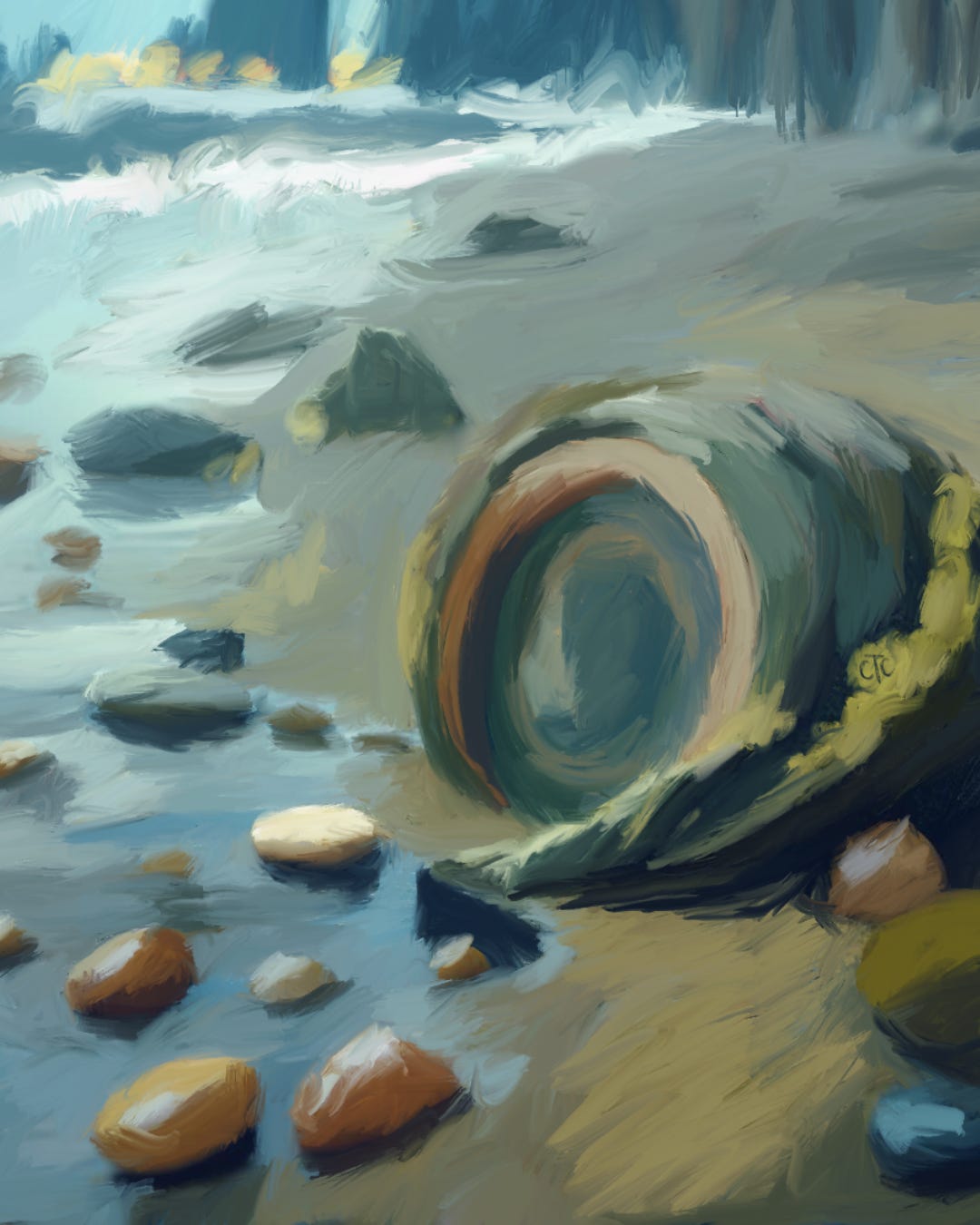
(I painted this in Procreate using the oil paint brush and have many opinions about it, but am leaving it alone - Chaiga T. Cheska)
Maeloc Brinehallow, Senior Fellow,
Concord Archives
Author of “Conversations with the Sea” (Concord Press, Third Edition)
Editor’s note: The manuscript “The Wave That Remembered Too Much” remains missing from the Archives. Brinehallow has been informed. He bowed to the empty shelf and returned to his desk without further comment.
(Loppelings Song, sung in the Way of Lon, song, language & music curation on Suno created by Chaiga T. Cheska)
I have spent twelve years visiting the same tide every morning before it left me so much as a shell, and I consider this rigorous methodology. My colleagues consider it Incident 4: the sitting. It is in the minutes.
The tide left me forty-seven shells over the years, eleven lengths of driftwood, a carved disc I have not yet identified, and one perfectly preserved sentence written in sand above the tide line one October morning: “Suunen waitaen for hwaen waitaen for ithaen”. Warmth and safety wait for those who wait for them, in the Way of Lon. I wrote it down and said nothing to anyone for three years.
In the twelfth year, the tide left me a stone that felt, unmistakably, as though it were paying attention. I set it on my notebook with appropriate care, bowed to it as is my custom upon meeting a new acquaintance, and waited. This is Incident 7: the bowing. Three weeks later, the door opened.
I shall address the central matter before proceeding: they are not spiders. They have eight legs, which I appreciate is an unhelpful coincidence, and I appreciate it particularly because I very nearly said the word aloud upon opening my notebook in the presence of the Loppeling from the tide, caught myself approximately half a syllable in, converted it into a cough, and sat for some moments recovering my composure whilst the Loppeling regarded me with its luminescent attention. I consider this one of the finer moments of my academic career. The Loppelings are aware of the comparison and will tolerate it exactly once. They do not indicate in any obvious way that they found it objectionable, which is considerably more uncomfortable than if they had.
Their bodies are compact, river-smooth, and pebble-coloured, faintly luminescent at the edges in a way that deepens when they are thinking hard. Their legs articulate with a soft and deliberate ticking, the sound of a clock that has decided to be gracious about itself. They live in small kin-clusters called tessels, communicate through clicks and leg-taps and a resonant hum produced by vibrating the inner walls of their stones, and measure time by the rate at which their stones weather. I find this reasonable.
Every Loppeling stone contains a door: oval, carved from the stone’s own face with a precision so complete that the seam is invisible until it opens. The interior is considerably larger than the exterior suggests. I spent the better part of an hour on my hands and knees with a magnifying lens pressed to the opening, attempting to reconcile this, and then lowered a length of thread through the door to gauge the depth of the chamber within. The thread ran out before it found a floor. I have since accepted that no amount of thread is going to resolve the situation to anyone’s mathematical satisfaction, and that several scholars before me have apparently reached this conclusion and simply gone for a long walk. I now understand why.
The Loppeling from the tide took four days to assess me. I returned each morning, greeted it in the Way of Lon as best I could at that early stage of study, and went home. On the fourth morning, it climbed onto my hand. I was so startled that I knocked my notebook into the sea. I retrieved it before it sank, but lost three pages of notes on depth perception and what the tide had told me the previous Thursday.
When it eventually departed, I bowed to the closed door. My research assistant resigned the following morning. He left a note explaining that the bowing had been manageable throughout our time together, that bowing to an open stone had been unusual but within the range of things he had agreed to, and that bowing to a closed door was where he had to draw his professional line. I remain entirely unbothered by this.
I should mention the manuscript. The tide took back the first draft of “The Wave That Remembered Too Much” at the forty-third page, mid-sentence, whilst I was examining a piece of kelp some twenty yards along the shore. I have reconstructed what I can from memory. This is Incident 12.
The Loppelings’ relationship to the Way of Lon is, in the opinion of this author, the most significant item in the current literature, and I arrived at it through twelve years of sitting on a beach and bowing to things. When I first attempted to address my Loppeling in the Way of Lon, my pronunciation was, by any reasonable assessment, poor. The Loppeling’s luminescence did not warm. They regarded me with the patience of a being that has been waiting considerably longer than I had been alive and could afford to wait considerably longer still.
When I finally produced something, the language would recognise as itself, the luminescence changed. It warmed at the edges first, then steadily throughout, in the manner of a lamp that has found the right oil. I made a note in my journal about this. The note is somewhat obscured by tea.
I have since established, to my own satisfaction if not yet the committee’s, that the Way of Lon is not a language the Loppelings adopted. It is a language they grew with. The distinction matters. The word Raelun means healing in the Way of Lon, and carries the root of dawn in its first syllable. This may not be coincidental.
The Loppelings have been here since before anyone thought to write anything down. They were in the riverbeds and the old walls and the foundations of abandoned watchtowers, whilst the rest of MirMarnia was still deciding what to call itself. They are still there now, ticking quietly, measuring time by the slow wearing of stone, opening their doors only for those who knock gently and wait. The tide, in my experience, operates on similar principles. Twelve years is not a long time to spend learning how to be patient enough for something worth finding. I recommend the methodology unreservedly, and I refer the committee to Incidents 4 through 14 for supporting evidence.
This paper, like the Loppelings themselves, keeps something hidden inside an ordinary surface. There are twelve letters scattered through this text, placed there deliberately, after the fashion of a tide that leaves particular things in particular spots for a particular person. Find them in the order they appear, and you will discover what they say. The Loppelings recommend patience. So does this author.
Ealwynen. Ealwynen. Ealwynen.
“All is well. All is well. All is well”.
Maeloc Brinehallow is Senior Fellow of the Concord Archives and author of Conversations with the Sea, which is in its third edition and which the Archives Committee has described as polarising. He is currently completing The Sea’s Diary, date of completion uncertain. The Wave That Remembered Too Much remains missing. Brinehallow visits the same tide every morning. The tide has not commented. On the matter of his public lecture in which he described the sea as emotionally manipulative, he stands by the characterisation.
Author’s Note:
Thank you for spending time with Brinehallow and the Loppelings today. This post went up on US Mother's Day, and if you look carefully, there is a hidden message tucked inside it, in letters scattered through the text, for my own mum, who has been the quietest and most patient presence behind this world for longer than anyone else.
If you are reading this and would like to send the same message to yours, the letters are there for you, too, and Brinehallow would consider it very appropriate methodology.
-Chaiga T. Cheska
Thank you, I got it!🙏❤️